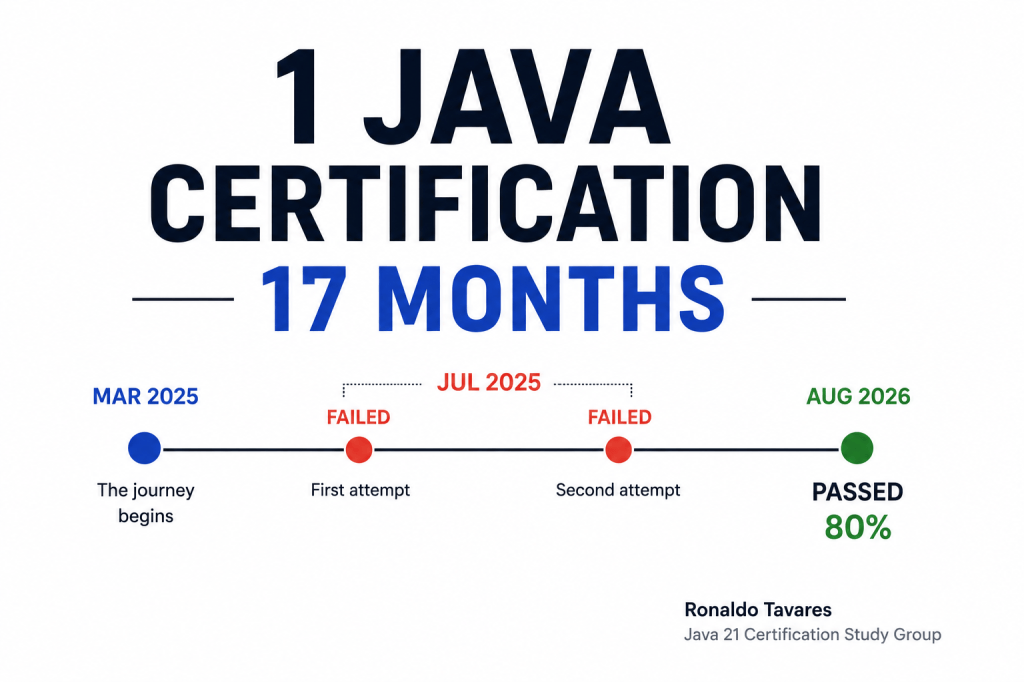
How a personal goal to update my Java knowledge became a 17-month journey, a community of hundreds of developers, two failed attempts, and finally an OCP Java 21 certification.
7 AWS certifications in 16 months.
1 Java certification in 17 months.
Yes, you read that correctly.
On August 21, 2026, after 17 months of studying, teaching, practicing, failing, trying again, and discussing Java almost every week, I finally passed the Oracle Certified Professional Java SE 21 Developer exam.
80%. PASSED.
But this story is not really about the 80%.
It is about everything that happened during those 17 months.
Why Java again?
I’ve been working with Java since 2010, and Java certification wasn’t something completely new to me. I earned my first Java certification, for Java SE 6, back in 2012, followed by Java EE and EJB certifications.
Years later, my focus shifted heavily toward cloud computing. At one point, I earned 7 AWS certifications in 16 months.
After that journey, I wanted to come back to Java.
I was already working with newer versions of Java, but I felt that I wasn’t really using many of the newer language features. I also wasn’t coding every single day anymore.
I missed getting my hands dirty with Java.
I wanted a goal that would force me to study consistently, explore the APIs, run code, make mistakes, and really understand what had changed in the language.
So I decided to pursue the OCP Java 21 certification.
My original plan was very simple:
Buy the book. Study. Take the exam.
Alone.
That plan didn’t last very long.
“Why don’t you do it in a group?”
During a group mentoring session with Bruno Souza, I mentioned that I was planning to study for the Java 21 certification.
Bruno asked me a very simple question:
“Why don’t you do it in a group?”
That question changed everything.
Why study alone if other Java developers were probably trying to achieve exactly the same goal?
Sometime later, during another mentoring session, Yugo Sakamoto suggested that I create a Discord server for the group.
I liked the idea, but I still took a few weeks to actually do something about it.
Then, one evening after work, I decided to stop thinking about it and just start.
That evening, I created the Discord server, set up a registration page and email list, and also created my own blog, ronaldotavares.dev.
I wrote the first article for the blog that same day:
“The Importance of Getting the Java 21 Certification.”
Read the original article from March 2025
Then I published a post on LinkedIn inviting other developers to study with me and used that article to explain why I believed pursuing the certification was worth it.
At that point, everything was still in Portuguese. The study group was initially created for the Brazilian Java community. It would only become an international community later in the journey.
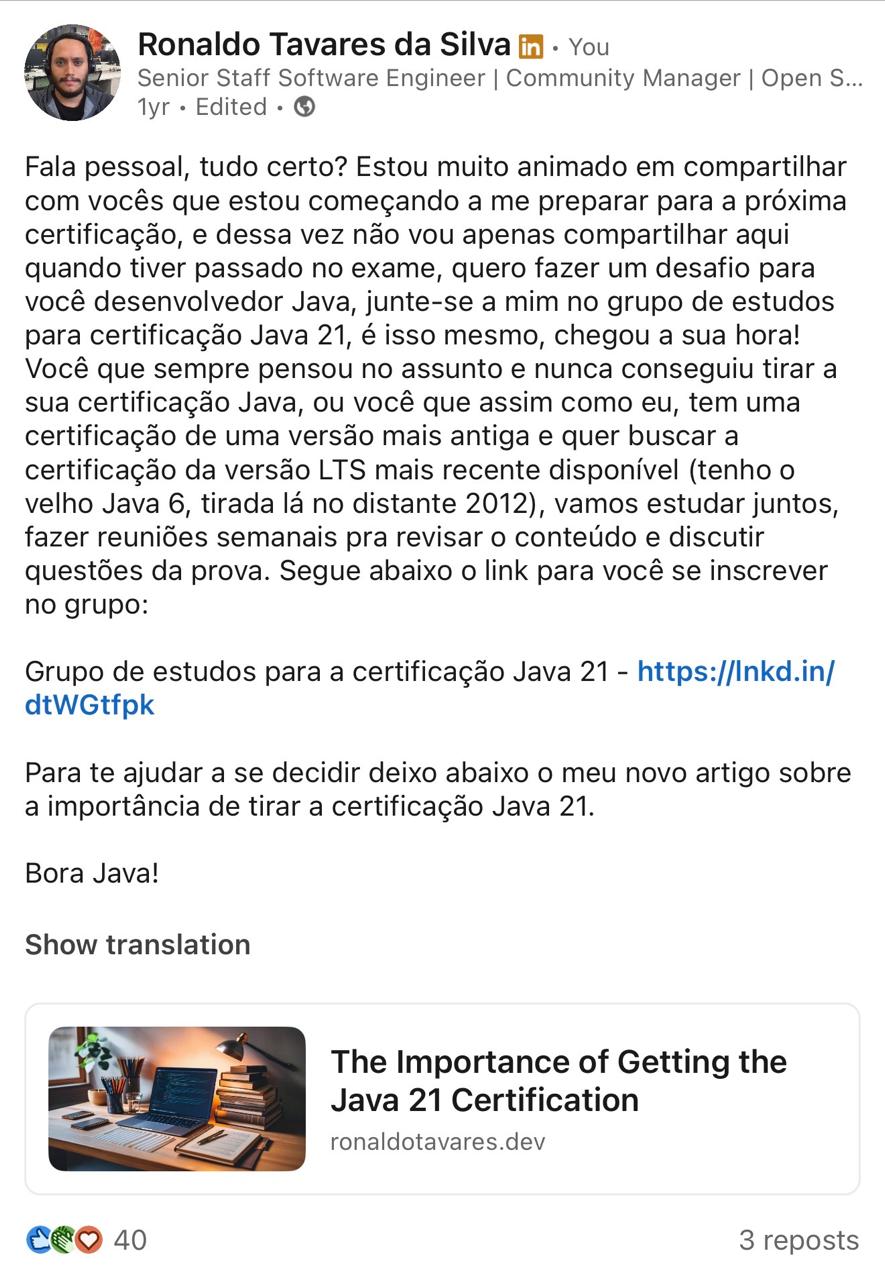
I went to sleep wondering if anyone would actually join.
The next day, there were three or four people. Then a few more. In about a week, we had around 20.
On March 19, 2025, I posted the first welcome message in our Discord server.
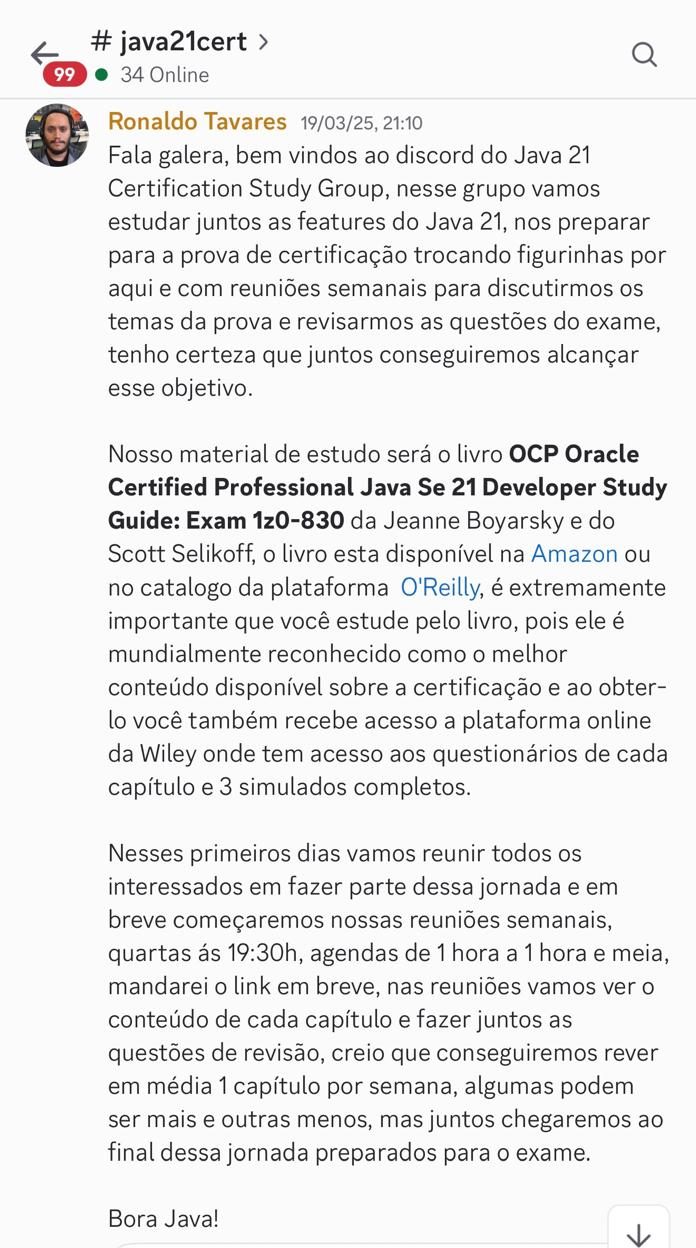
I wrote something in that first message that means much more to me when I read it today:
“Tenho certeza que juntos conseguiremos alcançar esse objetivo.”
“I am sure that together we will achieve this goal.”
I had no idea how long it would take me personally to achieve it.
And that was the beginning of the Java 21 Certification Study Group.
One chapter every week
We organized the first study cycle around the OCP Java SE 21 Developer Study Guide, by Jeanne Boyarsky and Scott Selikoff.
Fourteen chapters. Approximately one chapter every week.
To keep everyone moving together, I divided the book into its 94 study topics. The expectation was to study at least one topic a day, usually around 10 pages, with a minimum commitment of one focused 25-minute Pomodoro every day.
That was the baseline for someone following the study group.
But that was definitely not my own study routine.
As the person organizing the group, my preparation was much more intense.
I was reading the book and creating summaries in Portuguese for each study topic, which I posted every day. I prepared the slides for our weekly meetings. I created Google Forms with certification questions for us to discuss together. I studied the explanations for the correct and incorrect answers so we could talk about why each alternative was right or wrong.
What could be one Pomodoro of study for someone following the group often became several hours of Java study and preparation for me.
And every week, we met and discussed what we had studied.
Something interesting was already happening: preparing material for other people was forcing me to study differently.
But I didn’t realize yet how important that would become later.
Then Oracle gave us certification vouchers
During the first half of 2025, something great happened.
Through the community and Oracle’s Java Day: After One initiative, we received certification vouchers.
Around 25 people from our community received vouchers, including me. I got two opportunities to take the exam.
There was just one problem:
The vouchers expired on July 22, 2025.
We finished the book on July 8.
After months going through all 14 chapters, I now had roughly two weeks to consolidate everything, practice, and take the exam.
At the time, I saw two free opportunities to take the certification.
Looking back, I also see something else:
A deadline was deciding when I would take the exam.
Attempt #1 — 32/50
July 14, 2025.
Less than a week after finishing the book, I took my first attempt.
By then, I had already done several Enthuware mock exams, but one problem became very clear during the real exam:
Time.
The OCP exam gives you 50 questions and two hours.
And there was another factor for me: English is not my native language.
OCP questions can be long and very detailed. Reading and interpreting all that code and text under time pressure adds another challenge when you’re taking the exam in a language that isn’t your native one.
I was also used to AWS certification exams, where non-native English speakers can request an additional 30 minutes. I didn’t have that extra time here.
So those 120 minutes became one of the biggest challenges of the exam for me.
When I reached around question 45, I had approximately two minutes left. For the final five questions, I basically had to select answers without properly reading them.
Then came the result:
FAILED — 64%.
32 out of 50.
The passing score was 68%.
I had failed by exactly two questions.
That was frustrating.
But I still had one voucher.
And eight days.
So I went back to studying.
Attempt #2 — 31/50
July 22, 2025.
The final day of the voucher.
Between the two attempts, I did more mock exams and worked on my time management.
This time, I reached the end. I finished almost exactly when the clock ran out, and I actually felt that I had done better than on my first attempt.
Then the result appeared.
FAILED again — 62%.
31 out of 50.
This time, I had failed by three questions.
Ironically, I had managed the time better, reached every question, and felt better about the exam… but my score was actually lower.
That one hurt.
I had read the entire book, spent months studying Java, done several mock exams, and organized weekly meetings about the certification.
And I had failed twice in eight days.
Looking back, one of the biggest lessons seems obvious now:
Finishing the book is not the same thing as being ready for the exam.
But at that moment, I had another decision to make.
What now?
Back to Chapter 1
I didn’t immediately schedule another exam.
Instead, less than three weeks after my second failed attempt, we started again.
On August 11, 2025, I was back in our Discord channel posting:
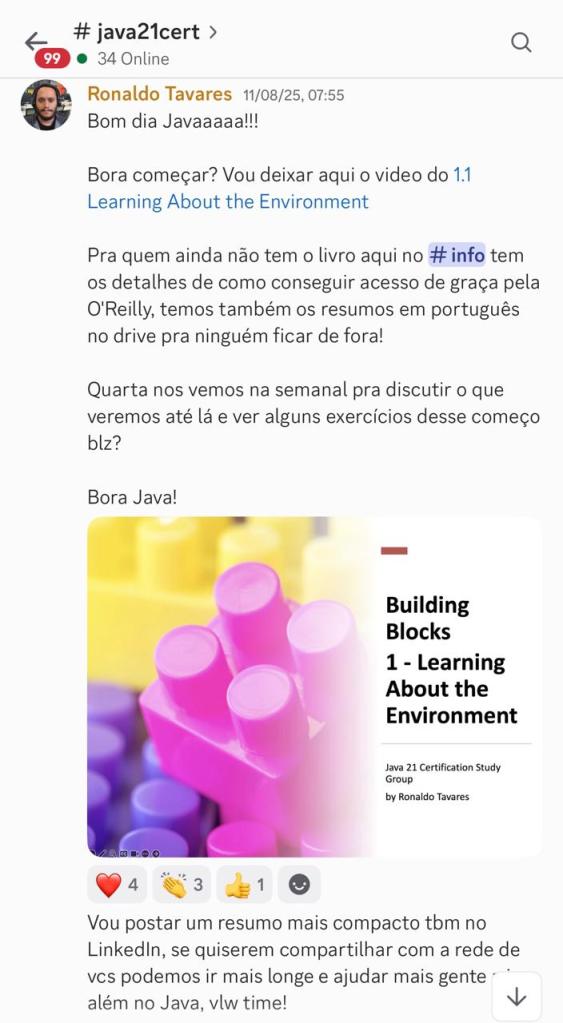
“Bom dia Javaaaaa!!! Bora começar?”
Or, in English:
“Good morning, Javaaaaa!!! Shall we start?”
Less than three weeks after failing for the second time, apparently my answer to failure was to go back to Chapter 1. 😄
And there I was again:
Chapter 1 — 1.1 Learning About the Environment.
But this second study cycle would be different.
The certification study guide was divided into 94 study topics, and I decided to build my second study cycle around all of them.
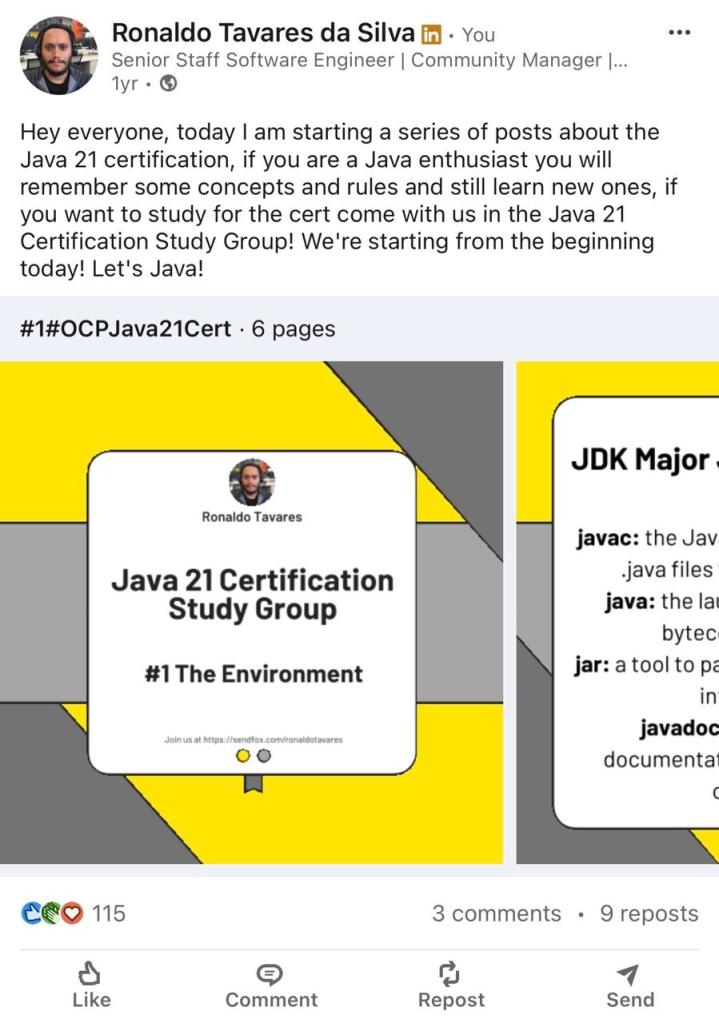
For each topic, I reread the material, studied the examples, prepared content, recorded a video, and created an English LinkedIn summary.
I also continued preparing our weekly meetings and discussing questions with the community.
During that second cycle, something had changed.
I wasn’t primarily studying because I had an exam scheduled. I was studying because I needed to explain the topic to other people.
And there is a huge difference between:
“I think I understand this.”
and:
“Can I explain why this works, why that doesn’t work, and answer the questions people will ask me about it?”
The first time, I studied the book because I wanted to pass the exam. The second time, I studied it because I needed to teach it. And that made a huge difference.
The community became bigger than the certification
Meanwhile, the study group kept growing.
As the community grew, we also had opportunities I never imagined when I created that first Discord server.
We started inviting people from the Java community for special sessions with our study group. Over time, we had the privilege of welcoming Jeanne Boyarsky, Professor Isidro, Elder Moraes, Rafael del Nero, Bruno Souza, and later Nicolai Parlog.
Suddenly, our members weren’t only reading a certification book and answering practice questions. We had opportunities to ask questions and learn directly from people with years of experience teaching, speaking about, writing about, and contributing to the Java ecosystem.
And people from our own community started passing the certification.
Thiago Bonfim became the first member of our study group to pass the Java 21 certification. Later, George passed too.
By 2026, developers from outside Brazil were increasingly joining our Discord server and asking about meetings in English.
What had started as a Portuguese-speaking study group for the Brazilian Java community was becoming international.
So we started an English study cycle alongside the Portuguese one.
Today, we have hundreds of developers in the community and weekly meetings in both languages.
After I finally passed, someone asked me whether the community had been an important motivation to continue after failing twice.
My answer was immediate:
Yes. For sure.
Without the community, I believe I would have given up.
After my second failure, people kept asking me:
“Are you going to try again?”
My answer was always the same.
Yes.
I didn’t know when, but I knew I would try again.
Giving up no longer felt like an option.
I started a community so we wouldn’t have to prepare for the certification alone. Eventually, that community became one of the main reasons I didn’t give up on my own certification.
This time, I would decide when I was ready
In 2026, I finally shifted my attention back toward my own exam preparation.
This time there was no voucher expiring in two weeks. No artificial deadline telling me when I had to take the exam.
I went much deeper into Enthuware.
I reviewed questions I got wrong, but I also reviewed questions I got right. When something wasn’t completely clear, I copied the code into my IDE, ran it, changed it, broke it, and tried to understand exactly what was happening.
I used Enthuware’s Leitner Mode to revisit concepts repeatedly, and sometimes I spent more time reviewing a mock exam than actually taking it.
During his own certification preparation, Thiago Bonfim had created a custom OCP test and published it in his GitHub repository. He mentioned it when we invited him to share his certification journey with the community.
Later, while preparing for my third attempt, I decided to take his test.
72 questions. 66 correct. 92%.
That was the moment when I felt:
I’m ready.
The difference between 2025 and 2026 can probably be summarized in one sentence:
The first two times, the voucher told me when to take the exam. The third time, my preparation told me when to take it.
So I scheduled attempt number three.
Attempt #3 — August 21, 2026
50 questions. 120 minutes. 68% required to pass.
And time was still my biggest challenge.
Some OCP questions are huge. You can have 20 or 30 lines of code in the question and five or six alternatives, with some alternatives containing many more lines of code themselves.
This time, however, I had done enough two-hour mock exams to know how to manage that pressure.
For most of the exam, I answered the questions in order. Toward the final quarter, I realized that I needed to make sure I reached question 50.
So I skipped three particularly long questions and marked them for review.
I reached question 50 with around 12 minutes remaining.
Then I went back to those three long questions.
The clock kept running.
I finished with a little more than one minute left.
I clicked Submit.
And almost immediately:
PASSED
80%.
I just sat there looking at the screen.
After 17 months, two failed attempts, hundreds of Java questions, countless hours of study, videos, slides, weekly meetings and discussions with the community…
It was done.
I thanked God.
And yes, I got emotional.
DONEEEEEEE!!!
There was just one problem.
It was still morning, and I had to work. 😄
I couldn’t immediately stop everything and make a big announcement.
At lunchtime, however, I couldn’t resist.
I opened the Daily Study channel on our Discord server and posted this:
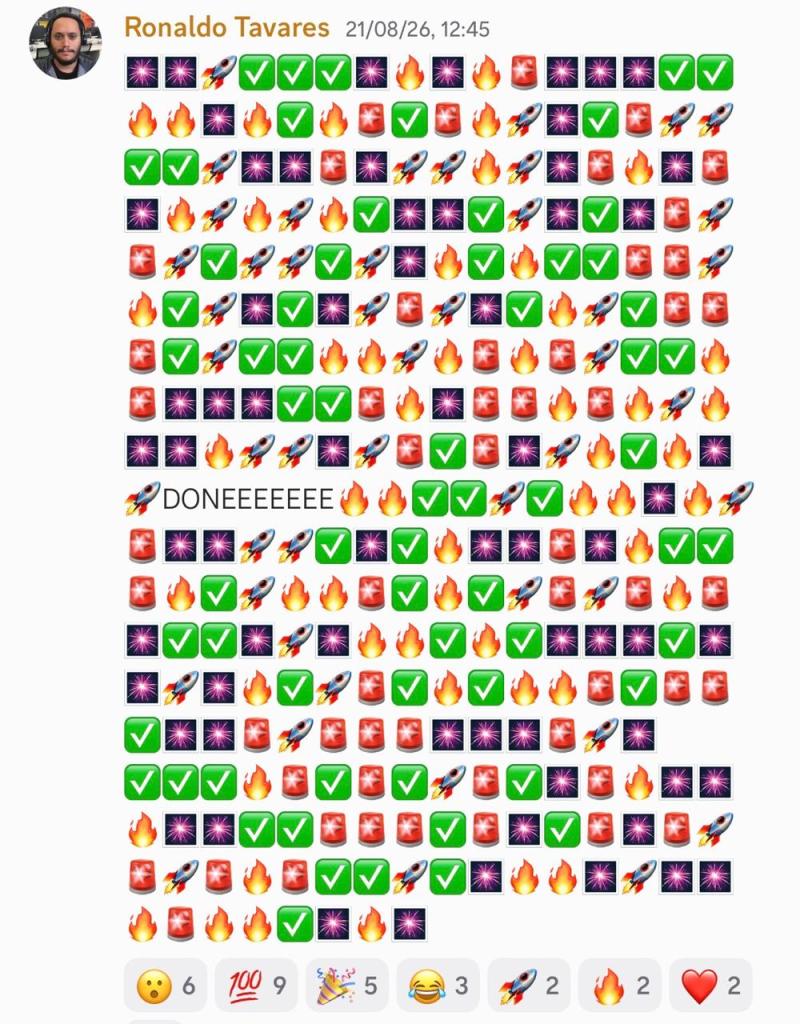
No explanation.
Just a ridiculous amount of emojis and, hidden somewhere in the middle:
DONEEEEEEE!!!
Some people immediately suspected what had happened.
Later that day, I finally shared the news officially with the community.
There was something very appropriate about telling them first.
They had been there through almost the entire journey.
Was it really worth 17 months?
Here’s something important:
You don’t need 17 months to prepare for the OCP Java 21 certification.
I certainly wouldn’t tell someone today, “Start studying now and come back in a year and a half.”
My preparation took 17 months because, somewhere along the way, it stopped being only about preparing for a certification.
I was studying Java while building a community, preparing daily content, recording videos, organizing weekly meetings, answering questions, teaching, learning from other developers, and watching people from our own study group achieve the same goal.
And somewhere in the middle of all of that, I failed twice and had to start again.
If my only goal had been to pass an exam, I would have wanted a much shorter journey.
But looking back now, I wouldn’t trade those 17 months for a shorter one.
Because the biggest result wasn’t the 80%.
And it wasn’t even the certification itself.
It was everything we built while pursuing it.
This is only the beginning
This is only the first article about this journey.
Over the next few weeks, I’ll share what I learned from my two failed attempts, how teaching changed the way I learned Java, how I used Enthuware and its 1,300+ questions, and the strategies that finally helped me reach that PASSED screen.
Next week:
How I Would Prepare for the OCP Java 21 Certification Today
If you’re preparing for the OCP Java 21 certification — or simply want to go deeper into Java — you don’t have to study alone.
Come study with us:
Join the Java 21 Certification Study Group
This article is also available on LinkedIn as part of my OCP Java 21 Journey series. Join the conversation there.
LET’S JAVA!!! ☕🔥


 Ronaldo Tavares
Deixe um comentário