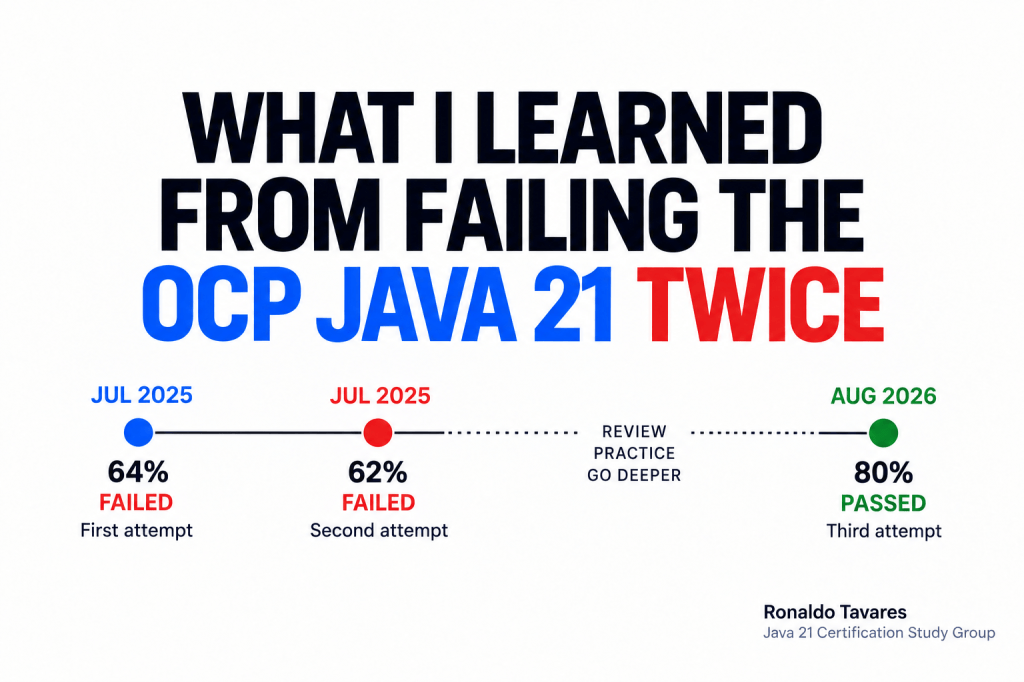
Six days after failing the OCP Java 21 exam with 64%, I tried again and scored one step lower: 62%. Here’s what those two failures taught me about the difference between being close to passing and actually being prepared.
On July 14, 2025, I took the OCP Java 21 certification exam for the first time.
The passing score was 68%.
I scored 64%.
32 correct answers out of 50.
I had failed by only two questions.
My first reaction was probably the most natural one:
I was almost there.
I had already finished the OCP Java SE 21 Developer Study Guide. I had taken several Enthuware mock exams. I had spent months studying Java and working through the content with the Java 21 Certification Study Group.
And now I was only two questions away from passing.
There was also one very obvious problem with my first attempt:
Time.
The exam had 50 questions and two hours.
When I reached the final five questions, there were only about three minutes left.
I barely had time to scan each question, check how many options I was supposed to select, and guess the answers.
I didn’t even have time to read the questions properly.
So the conclusion seemed obvious.
If I had managed my time better, maybe those two missing answers were somewhere among those final five questions.
Maybe I already knew enough Java to pass.
Maybe I just needed to become faster.
And I had six days to find out.
Six days later
I had received two certification vouchers from Oracle, and they expired on July 22, 2025.
I had one voucher left.
If I didn’t use it, I would lose it.
So I studied.
Before my first attempt, I had completed around eight Enthuware Standard Tests. During those six days, I continued taking mock exams, reviewing questions, and trying to improve my speed.
By the time I took the exam again, I had completed around 12 or 13 Standard Tests.
My biggest concern was making sure the same thing didn’t happen again.
I didn’t want to reach the final questions without enough time to read them.
On July 22, I took the exam for the second time.
And this time, I managed my time better.
I reached the end.
I answered all 50 questions.
I finished almost exactly when the time expired.
That alone made me feel that this attempt had gone better than the first one.
Then I got the result.
62%.
31 correct answers out of 50.
I had improved the thing that seemed to be my biggest problem.
And somehow, I had scored one question lower.
That result forced me to reconsider what I thought I knew after my first attempt.
Being close to passing isn’t the same as being prepared
After scoring 64%, it was very easy to look at the result mathematically.
I needed 34 correct answers.
I got 32.
Two questions.
That’s all.
But certification preparation doesn’t really work like that.
There wasn’t necessarily a list of exactly two Java concepts that I needed to learn before I could pass.
Those 32 correct answers came from one particular set of 50 questions on one particular attempt.
Another set of questions could expose completely different gaps in my knowledge.
And my second attempt did exactly that.
I was two questions away from passing. But I was much further away from being truly prepared.
That distinction became one of the most important lessons of my entire certification journey.
I had finished the Study Guide. I had done several mock exams. I had worked with the code. I had studied every chapter.
But there was still a difference between having studied the content and having consolidated that knowledge enough to consistently perform under exam conditions.
I needed more time reviewing the concepts I was getting wrong.
I needed to understand not only why an answer was correct, but why every other alternative was incorrect.
I needed to identify patterns in my mistakes.
When something surprised me, I needed to go back to the IDE, write code, change it, break it, and understand exactly what Java was doing.
And I needed enough repetition that the knowledge became easier to retrieve when the clock was running.
The second attempt showed me that I wasn’t missing just a few details.
My preparation needed another level of depth.
Time management was only part of the problem
Time absolutely mattered.
The OCP Java 21 exam gives you two hours for 50 questions.
Some questions can be answered relatively quickly.
But others can have five or six alternatives, each one containing 20 to 30 lines of code. The alternatives can look very similar, with only a few differences between them that determine whether an answer is correct or incorrect.
You need to read the question, understand the code, carefully compare the alternatives, remember how many answers must be selected, and make a decision.
Then you need to do it again.
And again.
Fifty times.
English is also not my native language, which adds another small layer of processing to every long question.
During my first attempt, having only three minutes left for the final five questions was clear evidence that my time management needed to improve.
But my second attempt taught me something equally important:
Solving the time problem alone wasn’t enough.
I managed the clock better.
I answered every question.
And I scored lower.
Time management was one part of being ready for the OCP.
Depth, consolidation, and consistency were the other parts.
The third attempt was different
More than a year later, when I prepared for my third attempt, there was no external deadline forcing me to choose a particular week.
I could continue studying.
I could review every mistake.
I could take more mock exams.
I could revisit weak topics.
And I could continue until the evidence from my preparation looked very different from what it had looked like before my first two attempts.
That difference can be summarized in one sentence:
The first two times, the voucher told me when to take the exam. The third time, my preparation told me when to take it.
That changed everything.
Instead of asking:
“How close am I to passing?”
I started asking:
“What am I still missing?”
The first question made me look at my score.
The second made me look at my preparation.
I went back to Chapter 1
On August 11, 2025, less than three weeks after my second failed attempt, I went back to Chapter 1.
But there is an important distinction here.
My first pass through the Study Guide had never been just about reading a book.
From the beginning, the community was already part of the way I studied.
For each topic, I prepared summaries in Portuguese and shared them with the group on Discord.
I created Google Forms with questions that we could work through together during our weekly meetings.
I prepared slides with explanations from the material and questions for review.
I also created a GitHub repository containing the code examples from the Study Guide.
And while reading the book, I was running those examples in the IDE, changing the code and experimenting with Java.
So I had already put a significant amount of work into the first study cycle.
But after failing twice, I decided to go further.
For my second pass through the Study Guide, I made a new commitment:
I would create content for every one of the 94 certification topics.
For each topic, I prepared slides and recorded a video in Portuguese.
From Monday to Friday, I published one video per day in our Discord server.
At the same time, I created an English carousel for LinkedIn covering that same topic.
That meant taking the same Java concept and processing it again and again in different ways.
First, I had to understand it.
Then organize it.
Then build the slides.
Then explain it out loud in a video.
Then rethink how to communicate the same concept visually and concisely in English.
This process consumed a large part of the second half of 2025.
But something interesting happened along the way.
Every time I transformed the material into another format, I had to confront the parts I didn’t understand as well as I thought I did.
It’s relatively easy to read an explanation and think:
“Yes, I understand this.”
It’s much harder to put the same concept on a slide and explain it clearly to another developer.
And when you’re recording yourself explaining it, gaps become even harder to hide.
The second time through the Study Guide wasn’t simply a reread.
I was repeatedly reconstructing the knowledge in different forms.
That became one of the most important changes in my preparation.
And it eventually taught me something much bigger about the relationship between learning and teaching.
But I’ll save that story for another article.
If you just failed the OCP
If you’re reading this because you recently failed the OCP Java 21 exam, especially if you were close to the passing score, it’s natural to focus on the number.
You calculate how many questions separated you from passing.
That information is useful.
But it shouldn’t be your only measure of readiness.
Look deeper into what happened.
Did you run out of time?
Were there topics that repeatedly made you uncertain?
When you got a mock question wrong, did you carefully study the explanation, or did you check the correct answer and move on?
Could you explain why the incorrect alternatives were wrong?
When a Java behavior surprised you, did you test it in the IDE?
Were your mock results consistently showing that you were ready?
Could you complete a full 50-question mock exam under the same time pressure as the real exam?
A failed attempt gives you something valuable:
information about your preparation.
Use it.
Don’t only ask:
“How many questions did I miss?”
Ask:
“Why did I miss them?”
And then:
“What do I need to change before I try again?”
For me, the answer wasn’t one thing.
It was time management.
It was deeper review.
It was more experimentation.
It was understanding every alternative in the mock questions.
It was identifying my weak areas.
It was repetition.
And eventually, it was teaching.
What those two failures changed
At the time, failing twice was frustrating.
Especially because after the first attempt, I thought I was extremely close.
But today, I see those failures differently.
If I had passed on my first attempt, I would have achieved the certification much earlier.
But I probably wouldn’t have gone back to Chapter 1.
I wouldn’t have studied all 94 topics again with the same intensity.
I wouldn’t have created the same amount of material.
And I wouldn’t have discovered how much deeper I could go into Java when I changed the way I prepared.
Thirteen months after those two failed attempts, on August 21, 2026, I took the OCP Java 21 exam for the third time.
This time, I wasn’t taking it because a voucher was about to expire.
I was taking it because, after everything I had done, I finally felt ready.
The result:
80%.
PASSED.
Looking back, the most important lesson wasn’t that I needed two more correct answers.
It wasn’t even that I needed to study more.
I needed to study differently.
My first failure made me think:
“How close am I to passing?”
My second failure made me ask:
“What am I still missing?”
That was a much better question.
And answering it changed not only the result of my certification exam.
It changed the way I learn Java.
If you’re preparing for the OCP Java 21 certification, you don’t have to study alone.
We are now more than 500 developers in the Java 21 Certification Study Group, with weekly meetings in Portuguese and English.
Come study with us:
https://sendfox.com/ronaldotavares
OCP Java 21 Certification Journey — Article Series
#1 — 1 Java Certification in 17 Months
#2 — How I Would Prepare for the OCP Java 21 Certification Today
#3 — What I Learned From Failing the OCP Java 21 Twice
You are here.
LET’S JAVA!!!


Deixe um comentário